Introduction
Abstract
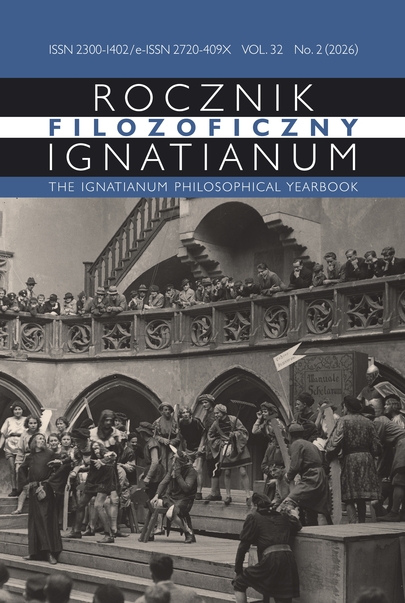
Student culture has long been an important element of academic heritage, shaping the identity of universities and bringing together successive generations of students. This issue opens with a collection of articles on customs, traditions, language, creative expression, and forms of student association across different eras and academic environments. The opening essay by Andrzej Gielarowski argues that student culture can be interpreted in terms of the theory of rites of passage developed by Arnold van Gennep in The Rites of Passage and further elaborated by Victor Turner (among others, in The Ritual Process), with a focus on the transitional (liminal) phase of the ritual. The author points to examples of student rituals that can be considered rites of passage due to the experience of community among the participants, which Turner describes as the experience of communitas, constituting an essential element of the liminal phase of every rite of passage.
Copyright (c) 2026 Ignatianum University in Cracow

This work is licensed under a Creative Commons Attribution-NoDerivatives 4.0 International License.
The Yearbook only accepts materials for publication that are free of all conflicts of interest, and that in no way involve conflicts over authorship, copyright, etc. The Editors will take action against any cases of plagiarizing, ghostwriting1, guest/honorary authorship2, etc. Where co-authored work is concerned, the Author listed first is expected to take responsibility for the submission, and is required to make clear the contributions of all of the Co-Authors involved. In the event of the publication owing its existence to funding dedicated to this purpose, this fact should be made clear: e.g. in any note of thanks/acknowledgement, or in a footnote, etc. Explicit notification should be given of any form of reprinting, with the appropriate evidence of permission to publish being furnished as required. Any impropriety on the part of Authors/Reviewers risks exposing them to appropriate responses from the relevant institutions.
______
1 This term refers to instances of a person who has made an essential contribution being omitted from the list of authors, or from notes conveying gratitude and/or acknowledgement.
2 This occurs when a person who has made either an insignificant contribution or no contribution at all nevertheless appears on the list of authors.