Archives
-
 Movement(s) and Identity
Vol. 53 No. 2 (2026)
Movement(s) and Identity
Vol. 53 No. 2 (2026)The present issue is the fruit of IV International City and Philosophy Congress which took place at the Ignatianum University in Cracow on 19–20 September 2024 under the theme “Movement(s) and Identity.” It was organized in collaboration between the Institute of Neophilology and the Institute of Philosophy under the leadership of the City and Philosophy Association, an international scholarly association and research network born in 2021, whose aim is to promote the knowledge related to urban studies and interdisciplinary approach to cities. It also attempts at strengthening and empowering citizenship structures, counteract exclusion, and foster constructive approaches to Otherness. In this it responds to the philosophy of the city, which is a novel development in contemporary philosophy and is little known in Poland. The organizing committee comprised of the then president of the Association, Prof. Julia Urabayen (Universidad de Navarra), Prof. Jorge León Casero (Universidad de Zaragoza), and the Ignatianum University’s team: Prof. Anna Bugajska, Dr. Marek Liszka, and Dr. Jacek Poznański SJ, thus uniting scholars interested in utopian studies, contemporary philosophy, migration studies and philosophy of science and technology. The resultant programme fostered discussion within carefully curated panels: City, History and the Arts; City, Society & Urbanism; Cosmotechnics, Ecosystems & Future Cities; Spaces, Migrations & Identities. The keynote lectures were delivered by Prof. Jacek Purchla (head of the Department of Economic and Social History and the UNESCO Chair for Heritage and Urban Studies at the Krakow University of Economics, Poland), Prof. Yuk Hui (Erasmus University of Rotterdam, Netherlands), and Prof. Adedoyin Teriba (Dartmouth College, USA). The event was attended by scholars from 18 countries (across 6 continents!), including Spain, Brazil, Colombia, Australia, Nigeria, China, the USA, the Netherlands, Germany and Peru.
-
 Medicine, Physicians, and Pharmaceuticals in Culture
Vol. 52 No. 1 (2026)
Medicine, Physicians, and Pharmaceuticals in Culture
Vol. 52 No. 1 (2026)“No one knows the value of good health until it is lost,” wrote Jan Kochanowski, the most renowned Polish poet, centuries ago. There is something deeply symbolic in the fact that this well-known verse from the epigram Na zdrowie (To Health) has become a proverbial expression, frequently quoted and recalled not only by scholars and enthusiasts of Old Polish literature. This is hardly surprising, as health and illness belong to the most universal existential universal human experiences. For this reason, medical issues can be examined from many different perspectives, including though the lens of their interdependencies and cultural contexts. Medical knowledge, therapeutic standards, medications and treatments used, as well as the social role and position of medical professionals, are all elements of a cultural reality specific both to a given place and to a particular moment in history.
-
 The Jesuit Cultural Heritage of Cracow and Małopolska Region
Vol. 51 No. 4 (2025)
The Jesuit Cultural Heritage of Cracow and Małopolska Region
Vol. 51 No. 4 (2025)Proponujemy Państwu lekturę kolejnego numeru „Perspektyw Kultury”, szczególnie dla nas ważnego tematycznie, ponieważ poświęconego wielowiekowym związkom Towarzystwa Jezusowego z dziejami kultury. Poszczególne artykuły stanowią badawczy namysł nad jezuickimi źródłami i śladami, współtworzącymi materialne i niematerialne dziedzictwo kulturowe. Obejmuje ono znaczenie wybranych postaci, wydarzeń, miejsc, dzieł i obiektów, dzięki którym kształtowały się więzi oraz budowały tradycje o jezuickiej proweniencji. Dziedzictwo to zarówno w perspektywie historycznej, jak i współczesnej niesie ze sobą uniwersalne, wciąż aktualne wartości, pozwalające wzbogacać oraz dopełniać wiedzę o przeszłości, kształtować tożsamość kulturową, a przede wszystkim prowadzić dyskurs o kulturowej roli Towarzystwa Jezusowego.
-
 Miscellanea Turcica et Orientalia
Vol. 50 No. 3 (2025)
Miscellanea Turcica et Orientalia
Vol. 50 No. 3 (2025)The current issue of our quarterly is inspired by the remarkable academic achievements and intellectual influence of Professor Ewa Siemieniec-Gołaś, who dedicated her scientific career not only to Turkology but also to teaching at the Chair of Turkish Studies at the Institute of Oriental Studies of the Jagiellonian University in Krakow. Through this issue, we aim to celebrate the Professor’s jubilee and express our deep gratitude and appreciation to her.
-
 Man – Art – Culture
Vol. 49 No. 2 (2025)
Man – Art – Culture
Vol. 49 No. 2 (2025)We are pleased to present to our readers this issue of Perspectives on Culture, in which the central theme is contemporary art – understood here as beginning in the 1970s – with particular attention to its current condition, relevance, and role within modern culture.
Art, like science, morality, and religion, is one of the fundamental expressions of human activity and thus constitutes a vital domain of culture. The continuous interplay between these spheres ensures that art remains in ongoing dialogue with science, morality, and religion.
-
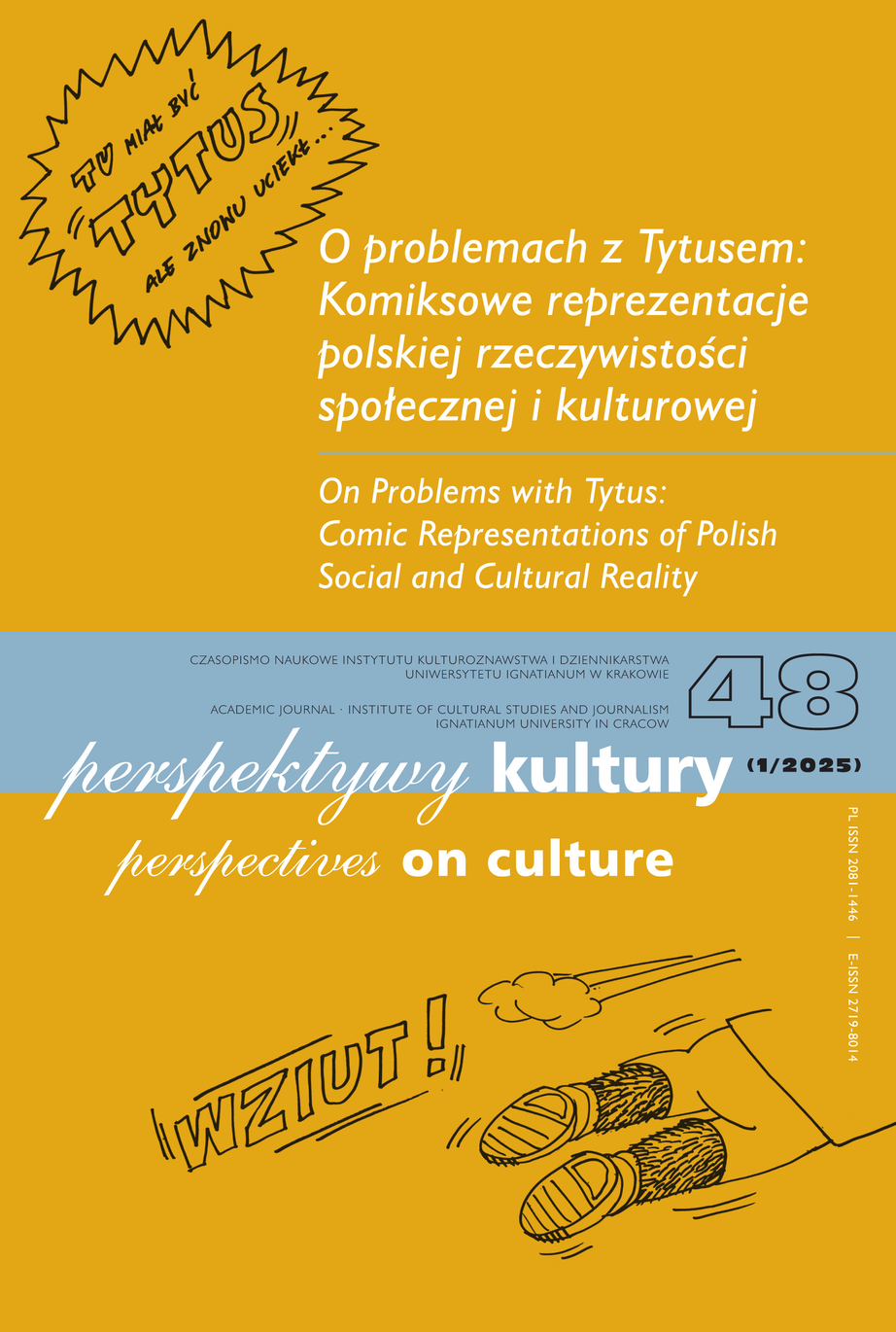 On Problems with Tytus: Comic Representations of Polish Social and Cultural Reality
Vol. 48 No. 1 (2025)
On Problems with Tytus: Comic Representations of Polish Social and Cultural Reality
Vol. 48 No. 1 (2025)In this section of the new issue of Perspectives on Culture, we aim to introduce readers to several important aspects of popular culture through the lens of comic art. We recognize that comic art is a product of popular culture and, as such, reflects significant trends within a given society’s culture while also providing creators with a space to present their own original vision of reality. This is simultaneously a realm of imagination for authors, for whom reality may serve as a subject treated in a realistic and historical manner or as an unconventional challenge that shifts artistic vision into the world of imagination, incorporating surreal or even fully surrealistic elements.
-
 Academic and Student Culture: History and the Present
Vol. 47 No. 4 (2024)
Academic and Student Culture: History and the Present
Vol. 47 No. 4 (2024)Temat kultury studenckiej – zaś w tym kontekście także i kultury akademickiej – cieszy się znacznym zainteresowaniem badawczym, czego przykładem jest niniejszy zbiór artykułów zogniskowanych wokół zagadnień związanych z jej dziejami i teraźniejszością. Jednocześnie zagadnienia łączące się ze zjawiskiem kultury studenckiej wywołują współcześnie wiele dyskusji i polemik, w których biorą udział zarówno badacze tego zjawiska, jak i jego dokumentaliści, twórcy ruchu studenckiego (z czasów Polskiej Rzeczpospolitej Ludowej), a także jego współcześni animatorzy.
-
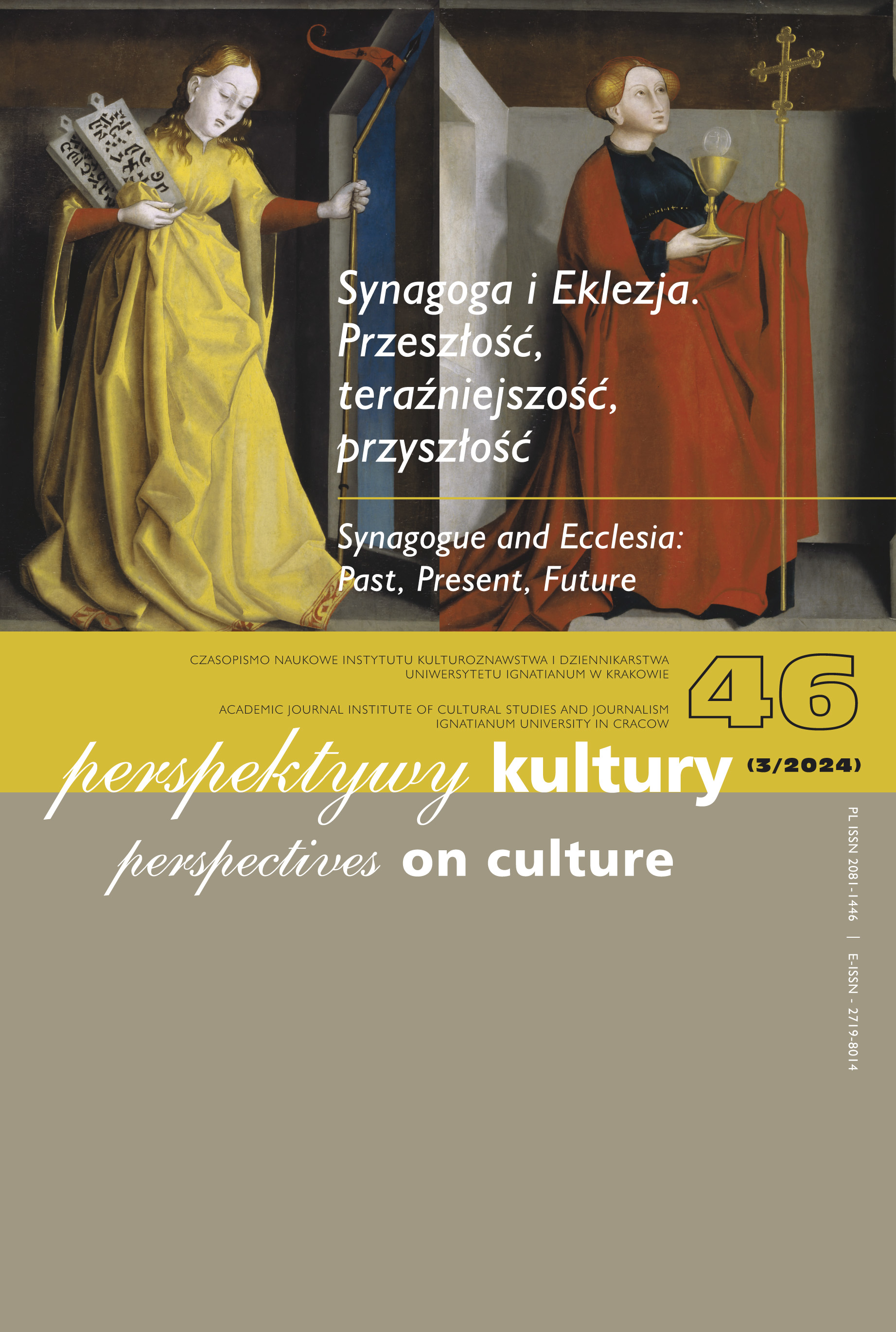 Synagogue and Ecclesia: Past, Present, Future
Vol. 46 No. 3 (2024)
Synagogue and Ecclesia: Past, Present, Future
Vol. 46 No. 3 (2024)Oddajemy w Państwa ręce kolejny numer Perspektyw Kultury poświęcony kulturze dialogu i dialogowi kultur. Tak się złożyło, że w bieżącym roku przypadła 20. rocznica śmierci orędownika dialogu międzyreligijnego księdza Stanisława Musiała, który należał do grona wybitnych jezuitów drugiej połowy XX w. Ojciec Stanisław Musiał SJ (1938–2004) znany był nie tylko jako orędownik dialogu międzyreligijnego, ale przede wszystkim pionier dialogu chrześcijańsko-żydowskiego i polsko-żydowskiego. Niniejszy jubileusz stwarza niezwykłą okazję do tego, aby przyjrzeć się dialogowi chrześcijańsko-żydowskiemu w teorii i praktyce. Obecny numer tematyczny Perspektyw Kultury zatytułowany jest Synagoga i Eklezja. Przeszłość, teraźniejszość, przyszłość. Jest w pewnym stopniu pokłosiem sympozjum związanego z wręczeniem nagrody imienia Stanisława Musiała SJ. W trakcie sympozjum zastanawialiśmy się nad relacjami między Synagogą i Kościołem. Czy Kościół jest nową Synagogą? Czy teologia zastępstwa jest nadal aktualna? Czy można jednocześnie być żydem i chrześcijaninem? Może trzeba być żydem, by być uczniem Jezusa z Nazaretu? Czy Kościół jest nowym Izraelem? Co więc ze „starym” Izraelem? Jak dzisiaj wyglądają relacje żydowsko-katolickie? Wspólnota żydowska i wspólnota uczniów Chrystusa mają za sobą dwa tysiące lat współistnienia, często trudnego i naznaczonego napięciami. Wspólna historia skłania nas do refleksji nad kategorią prawdy i całokształtem relacji chrześcijańsko-żydowskich.
-
 Kultura w mediach, media w kulturze
Vol. 44 No. 1 (2024)
Kultura w mediach, media w kulturze
Vol. 44 No. 1 (2024)The current issue of our quarterly is primarily dedicated to two leading themes. The first theme, “Culture in the Media, Media in Culture”, engages authors in a contemplation of the media’s role within contemporary communication-cultural rituals and presents the media sphere as a platform for the dissemination of cultural norms and values. Doctor Jarosław Kinal from the University of Rzeszów serves as the guest editor for this segment of Perspectives on Culture. The second leading theme is the “Historical City” under the editorship of Assistant Professor Andrzej Laskowski, professor at UEK. Within this section, authors endeavor to elucidate how urban communities have reacted to diverse crisis scenarios, which have concurrently served as remedies for the manifold afflictions encountered by urban spaces throughout history. Additionally, the issue comprises other works featured within regular sections.